
— Prior to WWI ~ 1901-1913
Let’s see what Wladyslaw got up to from what I do know from odds and sods I found online …
He graduated from the Marine Engineering College in 1901 and was fluent in five languages – Polish, Russian, French, English and German.
He was a Junior Mechanical Engineer on board the transport ship “Гонец” (Gonets) in 1902.
He was a Junior Mechanical Engineer on the “Рюрик” (Rurik) in February 1903 until 1904, when the ship was involved in overseas navigation.
He was an officer in the Black Sea Fleet Crew (Черноморский флотский экипаж) but there was no date of his time there 🤷
And from what I discovered in April 2022, he was made a staff captain on 09/01/1914!
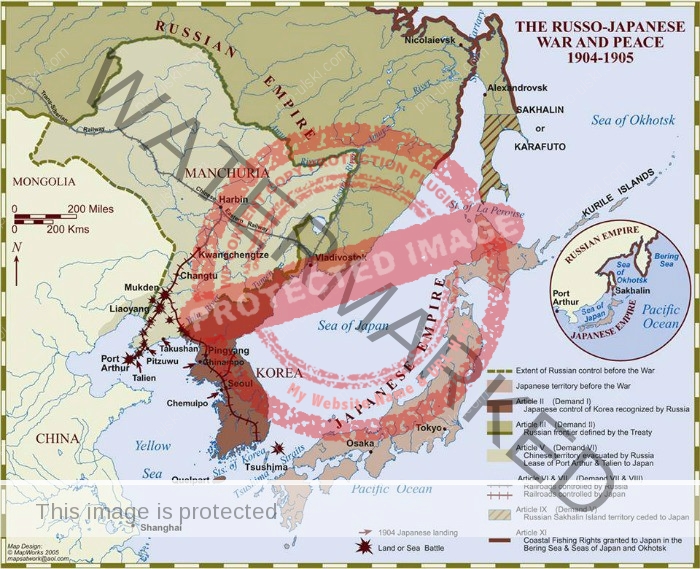
 In 1904 Russia was involved in the short but disastrous Russo-Japanese war but war was in the air from the beginning of the decade. All seamen and engineers who graduated were sent to the Pacific Fleet so I’m wondering about Wladyslaw’s time with the Black Sea Fleet.
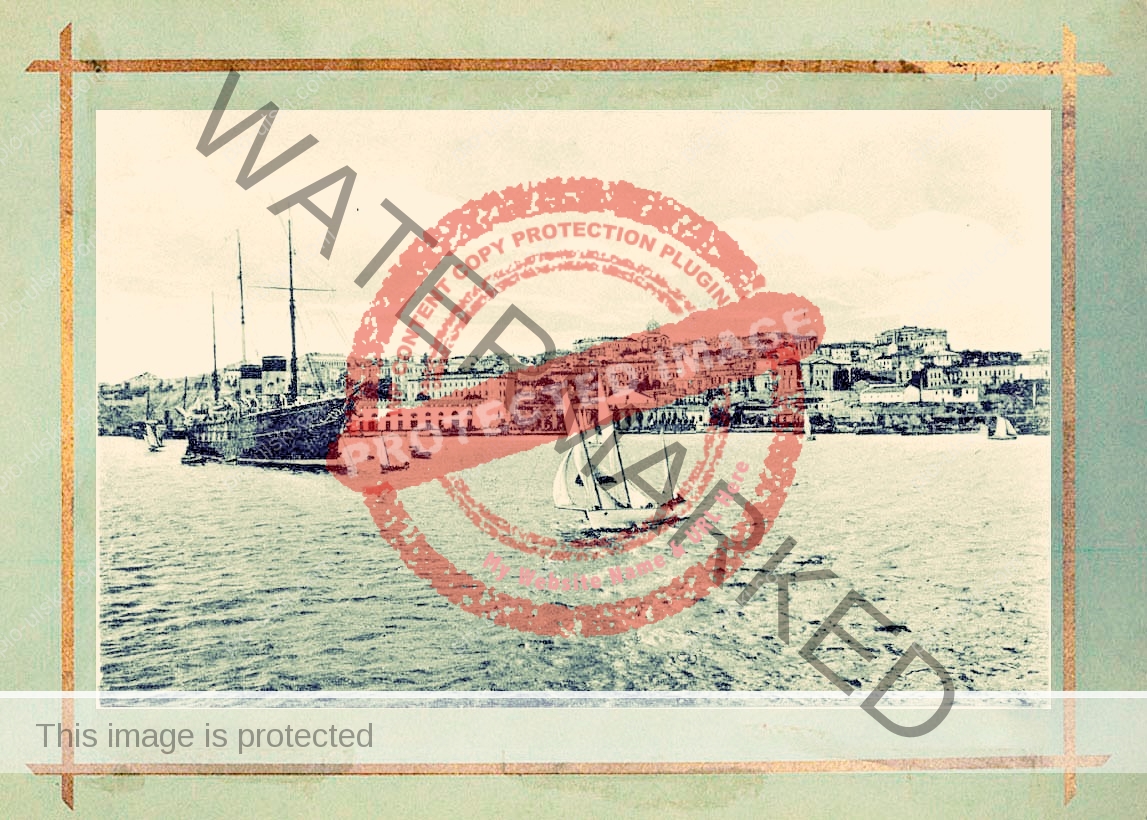
Sevastopol (Click to enlarge)
If he went to Sevastopol after graduating, it would seem obvious that he would have met Maria Makeeva, courted and eventually married her. Lyova was born in 1905 in Mogilev, so did Baba Manya stay with her in-laws during that time, then move back to the Crimea? I’ve come to that conclusion only because George was born in Odessa and then christened in Vladivostok, in 1911.
So if Wladyslaw joined the Rurik in 1903 as a junior mechanical engineer, would he have left his family in Crimea and joined the Independent Cruiser Squadron based at Vladivostok, or the First Pacific Squadron in Port Arthur, and got them to join him later? 🤷
When he was transferred to the Primorsky Region (Vladivostok), his salary would have increased by 180 roubles 😁
Now, again I have a report from my nephew 🤔
«Deda George’s father appears to have been a rather colourful person; there is evidence of his being a difficult student, he made himself unpopular by gate-crashing a number of formal parties given by the Viceroy of the Far East in Vladivostok in 1904 and he was actually court-martialled for desertion during the Port Arthur war with Japan in 1905. The proceedings went all the way to the Tsar’s desk, and the final outcome was a (significantly) reduced sentence of 40 days of guard house confinement for not being at his post for reasons outside of his control. This meant that he missed the sea battle of his ship (the Rurik) with the Japanese, during which many of the officers and men were killed.»
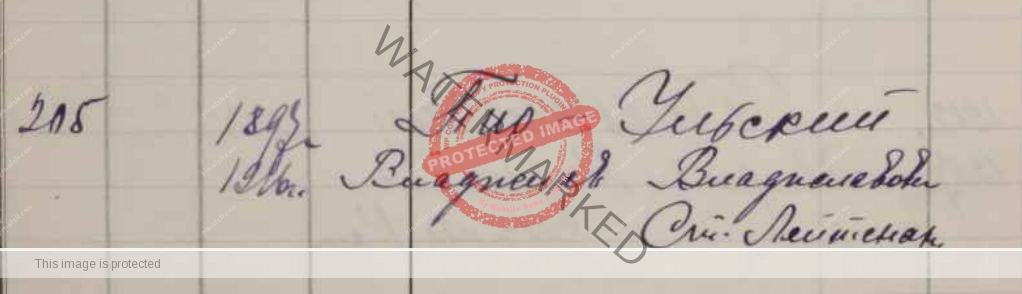
Found this little nugget from Chelombiko’s guidebook (Справочник Челомбитко), with another photo of Wladyslaw 😁
Translation:
Pio-Ulski Vladislav Vladislavovich, 28.09.1878., engineer- mechanic (2..7.1902), lieutenant “KIM” (01.01.1905), lieutenant “KIM” in reserve (26.12.1905). “Rurik” (served as mechanic) 23.2.1903-26.12.1905) brought before tribunal – (10.6. 1904) convicted for failure to appear on time for duty in wartime period. Engineer mechanic, first lieutenant (6.12.1914). Served in white forces on the northern front – from October 1918 on the Arctic Ocean flotilla. [Source:«Офицеры флота, Корпусов, Гражданские и Медицинские чины, Судовые священники Морского ведомства – участники Русско-японской войны 1904-1905 г.г.» by Челомбитко А.Н.]

You can download the pdf, which is in Russian, HERE

I have found discrepancies in the above statement as the Rurik sank during the Battle of Ulsan – on August 1904. It couldn’t have been that battle which Wladyslaw missed by being in the brig!
During the Battle of Tsushima, the Russians lost 12 battleships, 7 cruisers and 6 destroyers, so I need to find out if Wladyslaw was on one of those ships which ended up at the bottom of the sea ?
Also when I checked to see who was the «Viceroy of the Far East» at the time, the query came up as «Governor of the Far East», who was Admiral Yevgeniy Ivanovich Alexeyev. I’m therefore unsure of the proper title at the time ☹️
I can’t find any online reference to what he was doing in 1905 so until that little mystery is cleared up, we have to take what was said with a pinch of salt.
Now, on the Tsushima forum about «The crew of the cruiser Varyag», it says that :
Junior Mechanical Engineer Vladislav Vladislavovich Pio Ulsky 2nd Arrived 15/2/1903 of the crew. 23/02/1903 departed the CD I rank Rurik
Now, does that mean that Wladyslaw was on the ship Varyag, arriving at Port Arthur or Vladivostok on February 2, 1903, and then was transferred to the Rurik on February 23?
I found a photo of the officers of the Varyag but I don’t know the date.

However I was looking at the officer standing on the left hand side and wow! That was definitely my grandfather! One of the only photos of Wladyslaw I found on the Interwebz!!


The Rurik was involved in the Battle of Ulsan, also known as the Battle of the Japanese Sea or Battle of the Korean Strait, which took place in August 14, 1904. The ship was hit in her unarmoured sternpost and jammed her steering. Most of Rurik’s officers were killed in quick succession and so the chain of command was decimated. The Japanese ships knocked out Rurik’s guns and she then began to burn.

Sailors on the Rurik when it was hit by the Japanese (Click to enlarge)
Two Russian ships stayed with the stricken ship but they couldn’t help her. Two of the Japanese protected cruisers, Naniwa and Takachiho aimed their guns on Rurik and she started to list to port. As she began to sink, Rear Admiral Karl Jessen ordered the vessel scuttled and got his remaining ships to retreat to the base at Port Arthur.
The Japanese surrounded and laid siege to Port Arthur in August 1904. Approximately 6000 Russians were killed during the 5 month siege, an even larger number were wounded and at the end of it, the Japanese took about 20,000 prisoners of war.
Being the only stronghold that Russia had in that area, the loss of Port Arthur was both strategically decisive and totally humiliating for Tsar Nicholas.
****
I found out that, on 27 May 1905, the Japanese fired high-explosive shells at two of the Russian battleships, the Prince Suvorov (Knyaz Suvorov – Князь Суворов)and the Oslyabya (Ослябя), the latter having the rather dubious distinction of being history’s first all-steel battleship to be sunk by naval gunfire alone. There were different accounts as to how many men were lost but it was agreed that over half of the crew were lost when the ship sank.

The Oslyabya at Bizerte in 1903 (Click to enlarge)
Could that be the ship that Wladyslaw missed sailing on when he was locked up?
****
****
I have since found out that the Russo-Japanese War was financed by Jacob Schiff, who was the managing director of Kuhn, Loeb & Co!
Schiff had a virulent hatred towards the Tsar and his Government so he made sure that he supplied enough money to the Japanese Navy so that there would be no problem for them to beat the Russian Imperial Navy 😠
There is an excellent document about this subject which you can download HERE.
Another interesting pdf is …
Takahashi Korekiyo, the Rothschilds and the Russo-Japanese War, 1904–1907
Richard Smethurst recalls the genesis of the relationship between the Rothschild banks and one of the great figures in Japan’s history, Takahashi Korekiyo.
… which can be downloaded HERE.
“On the hills of Manchuria” (Russian: На сопках Маньчжурии, Na sopkah Manchzhurii) is a haunting waltz composed in 1906 by Ilya Alekseevich Shatrov, a military musician who served in the Russo-Japanese War, while the lyrics are the work of the poet Stepan Petrov, better known by the pen-name of Skitalets.
It refers to the Battle of Mukden, the final land battle of the Russo-Japanese War where the Russian army was decisively routed by the Japanese. The original lyrics are about fallen soldiers lying in their graves in Manchuria, but alternative lyrics were written later, especially during Second World War.«On the Hills of Manchuria» has become one of the most popular Russian songs, and has been transformed into urban folklore, with different versions coexisting with the original.
Regrettably the owner of the video has disabled the embed sharing so you can watch it by clicking on the link below …
https://www.youtube.com/watch?v=5dG8A3myCuU
Pio-Ulski.com claims no credit for any images posted on the site, unless explicitly stated.
All copyright goes to their respective owners.