
— 1908 List of Noblemen of the Mogilev Province
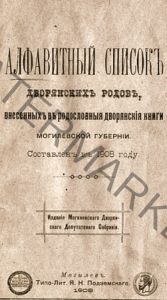
The full name is the «Alphabetical List of Noble Clans Included in the Pedigree of the Noble Books of the Mogilev Province» – the official printed publication of the Mogilev noble deputy assembly, which lists the noble names and persons with their titles, only the archive number from the noble fund and the number the order of each surname, and the part of the RDK into which they are entered.
The data of this list were published on the basis of the Genealogy book of nobles, which was conducted by the provincial leaders of the nobility by year and alphabet. After 1772-1782 and until 1917-1918. it was the only official publication of its kind in the Mogilev province. After 1917-1918 there was no reprint of this list. And at the time of publication of this article, there is no electronic copy of this publication on the Internet with open access for reading in the world. The list is presented in one copy of the original of this publication according to the catalogs in the historical scientific libraries of Ukraine, Russia and Belarus. And the modern NIAB archive officially announced the loss of archival manuscript sources in the Mogilev province that served as the source of this list. A similar reproduction is absent in the Vitebsk province of ethnic Belarus.
This list was published by the Mogilev Noble Assembly of Deputies in Mogilev in the printing press of Y. N. Podzemsky in 1909 with the permission of the Governor of Mogilev. The table of contents begins with a reference to the Code of Laws of the Russian Empire, article No. 968 of volume IX of the 1899 edition, with an explanation of the six-part list section. The text of the list is printed in Old Russian, noticeable efforts of the authors to convey in Russian the sound of Polish surnames from the Polish language. Some Polish surnames were ethnic Belorussians due to the rifling of Belarus. The authors of the list indicated reading options (also in parentheses). The printed text of the list does not have the Russian letter “ё”. There are German surnames with the characteristic prefix “von”, Italian-French – with the prefix “de”. Listed alphabetically, when there are double (or triple last names) with different uppercase letters printed through a dash, when determining where to enter such a last name in order, the authors of the list made a choice according to a common rule – which last name was preferred by the carrier of this last name (its main). Their total number in order is 1355 (there are namesakes written by the authors next to individual numbers in order, indicating different numbers of archival files, inside each part of the six available). The list is located on 23 printed pages. Their total number in order is 1355 (there are namesakes written by the authors next to individual numbers in order, indicating different numbers of archival files, inside each part of the six available). The list is located on 23 printed pages. Their total number in order is 1355 (there are namesakes written by the authors next to individual numbers in order, indicating different numbers of archival files, inside each part of the six available). The list is located on 23 printed pages.
This publication includes only a part of the oldest Sozh and Drutsk gentry (the old Belarusian gentry in the genealogy of which the historical period of the Radimichi tribe was encountered). Unfortunately, a complete list of nobles of the Russian Empire never existed. Even many recognized gentry in the Russian nobility in certain provinces of ethnic Belarus, already present in the provincial official publications were not published in all-Russian. So in the Memorial books of the Mogilev province was published in 1870-1871. (in the table of contents) The Imperial Decree with a list of Belarusian surnames of the nobility of the Grand Duchy of the Lithuanian Province of the Polish-Lithuanian Commonwealth, which referred to the parsing of the nobility and the refusal to recognize the Russian nobility, to transfer the old Belarusian gentry to bribes and bribes, the abolition of the ON and the elimination of its legal field (legal field), the formation of the Kingdom of Poland without its former influence on the ethnic territories of Belarus, the formation of a new administrative system, etc. reasons. Although there was a partition of Poland (after 1772), but the paperwork was conducted in Polish (for 1836 in the “Register of incoming papers for 1792-1836 on the issuance of letters and pedigrees” of the fund “Mogilev Provincial Noble Assembly” there is a record of paperwork still on Polish language for the issuance of a Russian noble diploma and copies of pedigrees recognized by the nobility in the Russian nobility in the Mogilev province). After 1917, they actively used this, as well as other lists of other provinces, in repressions – the seal of the Ministry of Internal Affairs of the USSR remained on the title page of this fund (f. 183 inv. 159 p. 1a). the formation of the Kingdom of Poland without its former influence on the ethnic territories of Belarus, the formation of a new administrative system, etc. reasons. Although there was a partition of Poland (after 1772), but the paperwork was conducted in Polish (for 1836 in the “Register of incoming papers for 1792-1836 on the issuance of letters and pedigrees” of the fund “Mogilev Provincial Noble Assembly” there is a record of paperwork still on Polish language for the issuance of a Russian noble diploma and copies of pedigrees recognized by the nobility in the Russian nobility in the Mogilev province). This, like other lists of other provinces after 1917, was actively used in repressions – the seal of the USSR Ministry of Internal Affairs remained on the title page of this fund (f. 183 inv. 159 p. 1a). the formation of the Kingdom of Poland without its former influence on the ethnic territories of Belarus, the formation of a new administrative system, etc. reasons. Although there was a partition of Poland (after 1772), but the paperwork was conducted in Polish (for 1836 in the “Register of incoming papers for 1792-1836 on the issuance of letters and pedigrees” of the fund “Mogilev Provincial Noble Assembly” there is a record of paperwork still on Polish language for the issuance of a Russian noble diploma and copies of pedigrees recognized by the nobility in the Russian nobility in the Mogilev province). After 1917, they actively used this, as well as other lists of other provinces, in repressions – the seal of the Ministry of Internal Affairs of the USSR remained on the title page of this fund (f. 183 inv. 159 p. 1a). reasons. Although there was a partition of Poland (after 1772), but the paperwork was conducted in Polish (for 1836 in the “Register of incoming papers for 1792-1836 on the issuance of letters and pedigrees” of the fund “Mogilev Provincial Noble Assembly” there is a record of paperwork still on Polish language for the issuance of a Russian noble diploma and copies of pedigrees recognized by the nobility in the Russian nobility in the Mogilev province). After 1917, they actively used this, as well as other lists of other provinces, in repressions – the seal of the Ministry of Internal Affairs of the USSR remained on the title page of this fund (f. 183 inv. 159 p. 1a). reasons. Although there was a partition of Poland (after 1772), but the paperwork was conducted in Polish (for 1836 in the “Register of incoming papers for 1792-1836 on the issuance of letters and pedigrees” of the fund “Mogilev Provincial Noble Assembly” there is a record of paperwork still on Polish language for the issuance of a Russian noble diploma and copies of pedigrees recognized by the nobility in the Russian nobility in the Mogilev province). This, like other lists of other provinces after 1917, was actively used in repressions – the seal of the USSR Ministry of Internal Affairs remained on the title page of this fund (f. 183 inv. 159 p. 1a). in the “Register of incoming papers for 1792-1836 on the issuance of letters and pedigrees” of the fund “Mogilev Provincial Noble Assembly” there is a record of paperwork still in Polish for the issuance of the Russian noble diploma and a copy of genealogies recognized in the Russian nobility in the Mogilyov province by the gentry). This, like other lists of other provinces after 1917, was actively used in repressions – the seal of the USSR Ministry of Internal Affairs remained on the title page of this fund (f. 183 inv. 159 p. 1a). in the “Register of incoming papers for 1792-1836 on the issuance of letters and pedigrees” of the fund “Mogilev Provincial Noble Assembly” there is a record of paperwork still in Polish for the issuance of the Russian noble diploma and a copy of genealogies recognized in the Russian nobility in the Mogilyov province by the gentry). This, like other lists of other provinces after 1917, was actively used in repressions – the seal of the USSR Ministry of Internal Affairs remained on the title page of this fund (f. 183 inv. 159 p. 1a).
Among the reasons for the refusal to recognize the old Belarusian gentry in the Russian nobility in the new political situation was participation in national uprisings due to lack of loyalty to the new political regime (Kosciuszko Uprising of 1794, participation in the 1812 war against Russia, Polish Uprising (1830), Polish uprising (1863), etc.); lack of compulsory service in the state (military) Russian service, etc. reasons. Among the gentry, compulsory military service was perceived without enthusiasm after the events of the death of the entire corps of the Minsk subunit formed from the gentry, when it was specially thrown by the Russian leadership into the crucible of the battle, while retaining military personnel from Russia. This explains the existing temporary break in the dates of official confessions and statements in the Russian nobility of the gentry by the Russian Sovereign Emperor [5]. Although the submission of documents officially to St. Petersburg by law was supposed to be submitted annually from each Belarusian province, but in the modern archives of the Russian State Archives of the Russian Academy of Natural Sciences and the Russian State Archive of Academies there is no clear annual archive about this for the period 1785-1917.
Moreover, the stratification (conditions of formation) of the Belarusian elite in the GDL was different from Russian realities – the formation of the Russian elite was fixated on material prosperity, biased emphasizing social status, which supposedly a distinctive feature of nobility for recognition in the nobility is material wealth. In this connection, the history of the creation of the category “noblemen of the noble palace” is interesting, as well as the maintenance of separate “audit tales” in this category [6]. Particular attention is drawn to administrative instability and deliberate confusion complicating the search for documentary evidence of gentry origin for recognition in the nobility, since the archives were formed precisely by administrative name, but no analytical work was done (where documents could get), this feature was not recorded in writing. there was no reference apparatus and information technologies (similar to modern ones). For example, the founded Mogilev province (1772) was renamed the Belarusian province (1796-1801), then it was again called the “Mogilev province” in 1802, and before that it was called the “Mogilev governorship” (1778-1796), and how nor strange with the center in the city of Vitebsk (not in the city of Mogilev). The same situation is in the districts, for example, in the jurisdiction of some settlements: Rogachev province, then – Rogachev district (since 1900 – Gomel district), and affairs of the Rogachev district were conducted until the 1850s. and in Belitsky Uyezd at all (renamed Gomel Uyezd in 1852). The new regime not only invented the complications of the recognition of the Belarusian gentry, but also methods of eliminating the former administrative division. For example,
Interestingly, in addition to the documents and the pedigree, the gentry was also obliged to give a Certificate from the Governor-General about the absence of political and criminal offenses. Many archives burned in fires and wars, paper did not withstand storage conditions in archives, etc., which complicated recognition. Because of the bureaucracy, there were cases of recognition of documents and genealogy by the gentry in other provinces, where they received recognition without delay. There were interesting cases when, in order to take possession of the rich estate of the Belarusian gentry, a new order official in the Belarusian provinces after 1772 informed, manipulated and influenced his fate (the Belarusian gentry from the wealthy estate fell into the estate of peasants, and a Russian nobleman began to live on his estate for free) . Russian officials were jealous and opposed to that the Belarusian gentry often encountered antiquities of 600-400 years or more when Russians had 50-100 years in the young state “Russian Empire”, the former Russian Empire (and in modern Belarus, every 10th citizen has a surname of a gentry). For the sake of objectivity, it is very important to understand in this matter the formed view from ethnic Belarus on Russia of that period (except for the subjective stereotype of Russian propaganda): In Russia in 1711 there was a Petrine reform in philology, instead of “Muscovites” write the self-name of subjects of the Russian Empire as “Russian ”(With two letters“ c ”) when the ancestors of Belarusians and Ukrainians were called“ Ruska ”with the root of the word“ Rus ”and one letter“ c ”(or“ Rusyns ”), as descendants of Russia. The ambitions of the national elite of Russia to “collect Russian lands” were viewed as a non-exclusive right of Russia.
There were cases when representatives of the ancient gentry were not recognized by the nobility and were not included in the 6th part of the RDK list, because of which they were forced to obtain approval in the Russian nobility through the public service (through Russian awards). This explains why different branches of the same genus (of the same surname) are found in different parts of the RDK list, although these are usually representatives of the same genus. It is important to take into account in the history of recognition in the Russian nobility of the gentry of this province of Belarus the fact of a conflict of mentality and worldviews on the social structure of society, since the Belarusian gentry had a mentality with the traditions of Veche Rus (the election of princes to rule), was in the Grand Duchy of Lithuania and was influenced by the Polish-Lithuanian Commonwealth. Where the Lithuanian Statute was a model for European countries,
In addition, a large number of Belarusian gentry was a competitor for Russian officials in establishing a new regime in society, which was important in the issue of the number of recognized gentry in the Russian nobility, and recognition of the rights of the Belarusian gentry equivalent to the Russian nobility. In the documents of the Grand Duchy of Lithuania you can find that all that is beyond the city of Smolensk to the east of the Grand Duchy is not Russia, but the Outskirts of Russia. The repression and discrimination of the new policy in the abolition of the Greek Catholic Church, the control of the Roman Catholic Church, which is noticeable when compiling the family tree when it is necessary to extract documents from Catholic metrics until the 1830s, played an important role. and after from the Orthodox in the same church of this province in Belarus. The gentry freedom in this province already had traditions then, when in Russia the nobility received it only in 1785 – A diploma on the rights, liberties and advantages of the noble Russian nobility. The gentry of this province found itself in a situation where, without its participation and consideration of its opinion, its fate was decided in 1772 by the Russian Empire, the Prussian Kingdom and the Austrian Empire during the First Partition of the Commonwealth. And the historical memory of the Belarusian gentry kept the forms of the genocide of Russian troops in Belarus (ethnic cleansing), Ukrainian Cossacks under the leadership of the Moscow Tsar (the death of half the Belarusian people). For example, in the city of Mstislavl in 1654, 15,000 people died at the hands of Russian troops, and about 700 residents remained alive. Mentioned is of fundamental importance for understanding the historical conditions for creating this list. liberties and advantages of the noble Russian nobility. The gentry of this province found itself in a situation where, without its participation and consideration of its opinion, its fate was decided in 1772 by the Russian Empire, the Prussian Kingdom and the Austrian Empire during the First Partition of the Commonwealth. And the historical memory of the Belarusian gentry kept the forms of the genocide of Russian troops in Belarus (ethnic cleansing), Ukrainian Cossacks under the leadership of the Moscow Tsar (the death of half the Belarusian people). For example, in the city of Mstislavl in 1654, 15,000 people died at the hands of Russian troops, and about 700 residents remained alive. Mentioned is of fundamental importance for understanding the historical conditions for creating this list. liberties and advantages of the noble Russian nobility. The gentry of this province found itself in a situation where, without its participation and consideration of its opinion, its fate was decided in 1772 by the Russian Empire, the Prussian Kingdom and the Austrian Empire during the First Partition of the Polish-Lithuanian Commonwealth. And the historical memory of the Belarusian gentry kept the forms of genocide of Russian troops in Belarus (ethnic cleansing), Ukrainian Cossacks under the leadership of the Moscow Tsar (the death of half of the Belarusian people). For example, in the city of Mstislavl in 1654, 15,000 people died at the hands of Russian troops, and about 700 residents remained alive. Mentioned is of fundamental importance for understanding the historical conditions for creating this list. The Prussian Kingdom and the Austrian Empire during the First Section of the Commonwealth. And the historical memory of the Belarusian gentry kept the forms of the genocide of Russian troops in Belarus (ethnic cleansing), Ukrainian Cossacks under the leadership of the Moscow Tsar (the death of half the Belarusian people). For example, in the city of Mstislavl in 1654, 15,000 people died at the hands of Russian troops, and about 700 residents remained alive. Mentioned is of fundamental importance for understanding the historical conditions for creating this list. The Prussian Kingdom and the Austrian Empire during the First Section of the Commonwealth. And the historical memory of the Belarusian gentry kept the forms of the genocide of Russian troops in Belarus (ethnic cleansing), Ukrainian Cossacks under the leadership of the Moscow Tsar (the death of half the Belarusian people). For example, in the city of Mstislavl in 1654, 15,000 people died at the hands of Russian troops, and about 700 residents remained alive. Mentioned is of fundamental importance for understanding the historical conditions for creating this list. and about 700 inhabitants remained alive. Mentioned is of fundamental importance for understanding the historical conditions for creating this list. and about 700 inhabitants remained alive. Mentioned is of fundamental importance for understanding the historical conditions for creating this list.
Shortly before the October Revolution of 1917, the so-called All-Russian Noble Genealogy Book was established by the Department of the Herald of the Governing Senate for persons who have served the nobility, but for some reason not included in the nobility of a certain province. The fact is that at the beginning of the twentieth century. noble assemblies received the right to refuse to be ranked as local nobility. Sometimes, at the same time, they were guided by the religion of these persons: without enthusiasm, for example, such petitions of persons of Jewish religion were considered. However, even a Christian could be denied the rank of nobility of this province. So, for example, the Moscow Nobility’s Deputy Assembly refused to include the princes Gantimurov, approved by the Senate in the dignity of the princes of the Tunguska, in the local genealogy book
Belonging to the nobility was proved in the provincial noble assembly; since 1785, that is, since the publication by Empress Catherine II of the “Granted Certificate to the Nobility”, persons recognized as noblemen by descent or by personal merit were entered into the provincial genealogy book; from the province, cases of the nobility were submitted for approval to the Senate’s Heraldry; Every year, lists of persons who were already included in the clans already approved by the nobility were sent there from the provincial assemblies. The origin of the nobility of a certain province was recorded in the track records of officials and military, although often it was not indicated the province by which their family was listed, but the province in which they themselves were born.
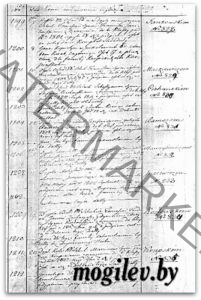
Alphabetical list of nobles included in the genealogy book of the Mogilev province:
page 1
1st part
A., Bronyuschets-Arasimovich, Artsishevsky, Bankovsky, Bashilov, Blazevic, Bobrowicz, Hermann-Bolondz, Garbuz-Bordzilovsky, B., Hrulinsky-Burbo, Boutkevitch, Bykovskii, Belyavsky Byalobrzhesky, Byalozor, Skarbek-Vazhinsky, Kostsyushko-Valyuzhinich, Wasilewski, Vatsuro, Velichkevich, Veraksa, Voynilovich, Yasenetsky-Voyno (Voyno-Yasenetsky), Wojciechowski, Karachevsky-Volk Volchkevich, Vonevich, Vorankovich (Voronkovich), Gavrilovich, Galkovsky, Adonevich-Lvovich-Galkovsky, Kolyumno-Gzatovsky, Germyevsky, Gerzdovsky, Gerzdovsky, Gerzdovsky, Gertyvskiy , Gineiko, Dzevyaltovsk d Gintovt Syrinsky-Guiraud, Glynco, Govarkovsky, Gozdzitsky, Goniprovsky, Gonserovsky, Ipatovich Gorski, Gorbatovsky, Griorkevich, Grinevich, Grodzsky (Grodsky) Grudzinski, Grushetsky, Gursky,
page 2
Daletskii, Danylovych, Deboy, Deschinsky, Dzevonsky, Dzerzhinskii, Dobrzhinetsky, Dobrowolski, Dobroselsky, Dovnarovich, Domoratsky (Domaratsky) Puzynko-Drobyshevski, Repoyto-Dubyago, Duhovetsky, Levalt-Yezerskiy (Yezerskiy) Essman, Zharin, Fours-Zhirkevich, Zhukovsky, Zavitnevich, Zagursky, Zakalinsky, Zalensky, Zalesky, Zarembo, Zarzhetsky, Zelenevsky, Radus Zenkovich, Ipatevich, Svenchits-Karchevsky, Katerlo, Zgersky-Kasho, Kvetsinsky, Kenshovich, Kiryatsky, Zagoretsky-Kisel Ratomsky-Kmitto, Kozhukhovsky, Goats Opoleansky, Kolachkovsky, Komornitsky, Konopelsky, Konosevich, Konyushevsky, Butkevich-Kopersky, Karaffa-Korbut, Korzhenevsky, Korzun, Bobrovsky-Korolko, Korotkevich, Korsak, Kosakovich, Kossachevsky, Kossovsky, Gleb-Koshansky,
page 3
Koshko, Krzyzhevsky, Near-Kulak, Gamrat-Kurek, Kulchitsky, Starzhenetsky-Lappo, Levansky, Levkovich, Lentchevsky, Liorentsevich, Lipsky, Lominsky, Lukomsky, Lyudogsky, Mayevsky, Malyushitsky, Zuyartovsky-Markiyovich, Menky, Markovsky, Markovsky, Markovsky Mizgaylo, Mizger, Milevskiy, Misevich, Mozheyko, Montvid, Moravian, Frost, Grinkevich-Mochulsky, Myshakovsky, Narkevitch, Niedzwiecki, Nepokoichitskii, Nestorovich (Nesterovich), von Nolken, Nosalevsky, Okinchits, Okulich, Olenski, Olehnovich, Klishko-Ollyak , Onihimovsky, Ordo, Osesimsky, Bonch-Osm sov, Ostashekevich, Orzheshko-Ostreiko, Ostrovsky, Padkovsky, vaidotas-Patsevich, Pyatkevich Pechkovskii, Piontkovsky, Dembinski-Pioro, Piorovich, Plavinsky, Podobed,
page 4
Poltoratsky, Polkovsky, Mishkevich-Popeiko, Porchinsky, Przhibylovsky, Protasevich, Puzirevsky, Pukhovsky, Putsillo, Rusinovsky-Putyato, Pyaskovsky, Radnevsky, Radushkevich, Ratomsky, Romanovich, Rohansky, Rusiyan, Rutkovsky, Ryzvych, Ryzvych, Ryzvych, Ryzvych, Ryzvych, Ryzvych, Ryzvych, Ryzvych, Ryzvych, Ryzvych, Ryzvytsky, Ryzvych, Ryzvych, Ryzvych, Ryzvych, Ryzvytsky, Ryzvytsky, Ryzvytsky, Ryzvytsky, Ryzvytsky, Ryzvytsky, Ryzvytsky, Ryzvytsky, Ryzvytsky, Ryzvytsky Savitsky, Sakovich, Saplitso, Svadkovsky, Sventsky, Sedmiogrodsky (Sedmiioigrodzky), Slavinsky, Sobansky, Spiontek-Sobolevsky, Sobolevsky, Sokolovsky, Chernilovsky-Sokol, Stolypko, Stopinsky, Zhukevich-Stosh, Stratanovich, Grzhevzhevsky, Strzhevzhevsky, Strzhevzhevsky, cue, Sushinsky, Schneider, Syritso, Tereshchenko, Tomkovich, Trembinsky, Tour, Uzhinovich, Fedorovich, Fliverk, Khaletsky, Kharkevich, Khlusovich, Khludzinsky, Khmyzovsky, Trukhanovich-Khodanovich,
page 5
Khotsyatovsky, Charnorutsky, Charnushevich, Kolovrat-Chervinsky, Chekhovsky, Chizh, Chugaevich, Musvits-Shadursky, Sharevich, Shafransky, Shelepin, Shelvinsky, Shendzikovsky, Shidlovsky, Shimanovsky, Shimkovich, Shimkovich, Shimkovich, Bitkovich, Shimkovich, Bitkovsky, Radzhivshtich, Bitkovich, Shimkovich, Bitkovich, Shimkovich, Bitlovich, Shushkevich, Ravich-Shcherbo, Yakutovich, Yalozo, Yankovsky, Yatskovsky.
2nd part
Agapeev, Alexandrovich, Andriyanov, Antipov, Arkhipov, Afanasyev, Bartoshevich, Beklemishev, Benediktovich, Behli, von Biterlich, Borzov, Budogovsky, Bursky, Belsky, Velichko, Vlasyev, Yasenetsky-Voyno (Voino-Yasenetsky),
page 6
Volukevich, Gadzyatsky, Gaydkevich, Gartz, Gattovsky, Gebel, Herburt-Geybovich, Gelyashevich, Gerasimov, Gizycki, Dzevyaltovsky-Gintovt, Glindich, Glovatsky, von Goyer (von Goyer), Golyshev, Gonipovsky, Gorizovsky, Goripovsky, Goripovsky, Goripovsky, Goripovsky, Goripovsky, Goripovsky, Goripovsky, Goripovsky, Goripovsky, Goripovsky, Goripovsky, Goripovsky, Goripovsky, Goripovsky, Goripovsky, Goripovsky, Goripovsky, Goripovsky, Goripovsky, Goripovsky, Goripovsky, Goripovsky, Goripovsky, Goripovsky, Goripovsky, Goripovsky, Goripovsky, Goripovsky, Goripovsky, Goripovsky, Goripovsky, Goripovsky, Goripovsky, Goripovsky, Goripovsky, Goripovsky , Greshner, Gribovsky, Grigoriev, Gursky, Gyubbenet, Denysenko Denisov, Derozhinsky, Odynets-Dobrovol’skii Dombrowski, Domoratsky, Dubovetsky, Duhovetsky, Dyshlevsky, Diakov, Evseev, ENAC, Zhirkevich, Zhuravskiy, Zgorzhelsky Zorin, Ivanov, Karnilovich, Karchevskii , Drekalovich-Skander-beck-Kastriot, Kens ovich, Kepping, Kirik, Kisilevsky, Kislovskiy, Kluev, Kozlowski Knee (Knee) Konigovsky, Concha,
page 7
Korzhenevsky, Korolko, Korytko, Koshanskiy, Koshko, Kretkovsky, Krzhizhanovsky, Krivykh, Kuznetsov, Kukharsky, Labutaev, Lappo, Leitner, Lepkovsky, Link, Lisovsky, Lobanovsky (Labanovsky), Lukavsky, Luskin, Malafeev, Matyuner, Muryuns, Meruen, Mauren, Mauren, Mauren, Mauren, Mauren, Mauren, Mauren, Mauren, Mauren, Mauren , Mineman, Mitkevich, Mozheyko Moritz, Moskalev, Musman, Myasoedov, Nekrasov, Nepokoichitskii, Nozhin, Nosovich, de Opagin, Oskerko, Oshmyanets, Patsukevich, crossed, Peroshkov, Petrikov, Padalinski, Krzhevkovich-Pozniak, Polyansky, Poltoratsky Popov , Pravikov, Przhevalinsky, Radchenko, Fen-Raevsky, Redzko, Ro Dionov, Savoscitsky, Serdakovsky, Semirovsky, Rudnitsky-Sipailo, Sikhro, Skoblikov,
page 8
Skorobogaty, Slavinsky, Smolsky, Spytko, Stakhovsky, Stepanov, Stetkevich, Stephanie, Term, Titov, Tumsky, Fedorovich, Filipiev, Khilinsky, Boreyko-Khodkevich, Khoetsky, Khokhlov, Khotsyanovsky, Khreptovich, Tsykhinsky, Tsytovich, Chobovich, Chobovich, Chobovich, Chobovich, Chytovich, Chytovich, Chytovich Shebeko, Shipinsky, Shklyarevich, Gorsky-Shpyrko, Shulgin, Yaroshevsky.
3rd part
Alabushev, Alexandrov, Ananich, Andreshevich, Antoshkevich, Aristarkhov, Babich, Baranovich, Bartolomei, Bartoshevich, Bezsonov, Bekarevich,
page 9
Beckman, Benevsky, Bernadsky, Betulinsky, Biryukovich, Bobrik, Bogdanovich, Bogushevsky, Boltsevich, Borkhman, Brezhezinsky, Bulakhov, Butenko, Belofostov, Vatatsi, Weinreich, Veremenko, Vishnevsky, Volkovitsky, Volkovich, Karachevsky, Volkovich, Gachevsky, Wolf Geltzl, Gerard, Young Man-Gzovsky, Girilovich, Syrinsky-Giro, Smooth, Glinsky, Glushanovsky, Glybovsky, Golovatsky, Golynsky, Dashkovich-Gorbatsky, Gornovsky, Goryachkin, Grebnev, Grinevich, Gudkov, Gusakovsky, Grantovsky, Wrangel, Wrangel, Wrangel, Wrangel Daletsky, Korybut-Dashkevich, Demyanovich, De Yantsevich, Dzichkanets Dmitriev, Dobzhansky, Dolivo-Dobrovolsky, Dobrovolsky, Dombrowski, Dulevich, Epifanov, Zhilkin, Zagorovsky, hares,
page 10
Zvonarev, Zinoviev, Zubovsky, Zuev, Ivanov, Ignatiev, Ilinich, Kaliopin, Kaminsky, Karnozhitsky, Karpinsky, Kimbor, Kirilovich, Kiryatsky, Kislikov, Kitaevsky, Kovalyk, Kozakov, Kozlovsky, Kozhevnikov, Kolyankovsky, Kopytkovsky, Porze-de-Peze Kulyako-Koretsky, Korzhets, Korkozovich, Kornilovich, Kossachevsky, Kostenich, Kravchenko, Krantz, Krasevich, Krassovsky, Kroger, von Cruz, Krutilov, Kraeger, Sementovsky-Kurilo, Kutorga, Kushin, Ladomirsky, Lazarevich, Lachenko, Lakoevp, Lak, Lakarevap, Lako, Lako, Lak, Levarep, Lak Pora Leonovich, Lepeshinsky, Lesnevsky, Lechitsky, Leshko, Loganov, L Opatenkov, Lappato, Lorchenko, Luzhinsky, Desyatino-Lukyanov, Lysov, Lyudogovsky, Lyutovsky, Malevich-Malevsky,
page 11
Malinovsky, Mankovsky, Martsinkevich, Matskevichi, Meyer, Merkushev, Melnikov, Monnerot-du-Men, Merlin, Migai, Mikosha, Miropolsky, Mikhalovsky, Modestov, Portyanko-Monko, Moskovenko, Grabya-Murashko, Neyshventer, Nikotenko, Nichich Nosovich, Ozmidov, Olekhovsky, Olshevsky, Ostrovsky, Ostroumov, Ochochinsky, Pazdeev, Panchenko, Paprotsky, Pashinsky, Pelrashkevich, Penkin, Peters, Petkevich, Petrashen, Pechkovsky, Pioulsky, Plotsky, Podashevsky, Pokrovsky, Polomsky, Polomsky, Polomsky, Polomsky, Polomsky Prigorovsky, Pukhov, Radk Evich, Radchenko, Rakhmanin, Rego, Renteln, Bronyushets-Retsky, Retsky, Rodkevich, Roland, Romankevich, Romushkevich, Sommerset-Rosseter,
page 12
Roshkovsky, Rubanovsky, Savastyanov, Savinich, Savitsky, Savich, Sakk, Sapriko, Sarbievsky, Sverchkov, Semkovsky, Serdyukov, Serafimovich, Sivitsky, Sidorsky, Sinitsyn, Skalyshevich, Skorobogaty, Smyarovsky, Sozlogevich, Stozhovich, Stoklovich, Stoklovich, Sokolov, Stokolovich, Sokolov, Sokolov, Stokolovich, Sokolov Stepanov, Stos, Stratanovich, Sudzilovsky, Sukhodolskiy, Taratkevich, Tarhov, Teplinin, Tihovsky, Trzhetsyak, Trupchinsky, Turchaninov, Tydeman, Fasch, F., Frendt, Funk, Khomentovsky Hotsyanovsky, Tsekert, Dorshprung-Tselitso, Tsekhanovsky, Tsytovich, Cham, Chachkov, Chervyakovsky, Chernyaya Swedes, Shebunina, Shklyarevich, Shmelev,
page 13
Gulpovsky-Schulz, von-Schulz, Schuht, Scherbakovich, Yankovsky.
4th part
Grobua, Pischevich (Pishchevich), Francesson.
5th part
Baron Bremzen, Graf Grabovsky, Prince Kropotkin, Prince Dondukov-Korsakov, Prince Lubomirsky, Prince Meshchersky, Baron von Nolken, Prince Obolensky, Prince Erivansky-Paskevich, Count Sumarokov, Prince Drucka-Sokolinsky, Count Tolstoy.
page 14
6th part
Abakanovich, Avtushkevich, Adamovich, Lelevich-Adamovich, Aleksandrovich, Antushevich, Artsimovich, Artsishevsky, Bagensky, Baykov, Bankovsky, Baranovsky, Bartoshevich, Berlin, von Benckendorf, Bibikov, Bilevich, Bialynitsky-Biruyavsky, Bogulovsky, Bogulovsky, Bishurovsky, Bishurovsky, Bishurovsky, Bishurovsky, Bishurovsky, Bishurovsky, Bishurovsky, Bishurovsky, Bishurovsky, Bishurovsky, Bishurovsky, Bisluvsky, Bishurovsky, Bishurovsky, Bishurovsky, Bishurovsky, Bishurovsky, Bishurovsky, Bishurovsky, Bishurovsky, Bishurovsky, Bishurovsky, Bishurovsky, Biryubovskiy, Biryubovsky, Biruvsky, Bishurovsky, Bishul Bonch-Bogdanovsky, Bogomolets, Bogushevsky, Bogush, Morduchai-Boltovsky, Boreyko, Boreisho (Boreisha), Borisovich, Bork, Bochkovsky, Borodzich, Brzezia-Brzezinski, Brzhozovsky, Brzhostovsky, Brochovich, Bonch-Bruevich, Bonch-Bruevich, Budch-Bruevich, Budch-Bruevich, Buffalo, Bulgak, Burachek, Boer, Brown, B utovich, Butsevich, Buchinsky, Belevsky, Belikovich, Bodzento-Belyatsky, Belyatsky, Biberstein-Bialkovsky, Bykovsky, Vakar, Valakhovsky, Kostyushko-Valyuzhinich, Vasilevsky, Vaskovsky (Vaskovsky), Vankovich,
page 15
Varpakhovskii, Vartman, Vevel, Veysengoff, Vialichka, Velyamovich, Ventslavovich, Wierzbicki, Verenko, Verzhensky, Verozumsky, Kostyushkevich-Wigura, Vilenchits, Wilczynski, Vilyamovsky, Viskovsky, Witkowski, Gold Wisniewski, Voevodskii, Voeikov, Potulitsky-Voyzbun, Nyankovskiy- Voynilovich, Yasenetsky-Zheretinsky-War, Wojciechowski, Karachevsky-Wolf, Lanevsky-Wolf, Volodzko, Volodkovich, Vollovich, Volynsky, Furs-Vonsyatsky, Voronets, Voropay, Vroblevsky, Vykovsky, Vasilevich-Vyryvichimov, Gysotsky, Gysotsky, Gysotsky, Gysotsky, Gysotsky, Gysotsky, Gysotsky Galinovsky, Adone HIV-Lvovich-Galkovsky, Gankevich, Gaspersky, Gauger, Gatsky, Gedroits, Rodetsky-Geliashevich, Gerdzeevsky, Gizycki, Glasko, Gogolinsky, Golubitsky, Golynsky, Goniprovsky, Gorbatsky, Gordsyalkovsky, Gornovsky, Buryat-Gorodtsky, Gorodtsky, Gorodtsky, Gorosht
page 16
Grebnitsky, Gregorovich, Grzhibovsky, Grum-Grzhimailo (Grumm-Grzhimailo), Grinevich, Grinevsky, Grintsevich, Gromyko, Grokhovsky, Radobylsky-Gubarevich (Ratobylsky-Gubarevich), Guminsky, Romeyko-Gurko, Mitskiewicz-Dal’kevich-Dal’kevich-Dal’kevich-Dal’kevich-Dal’kevich Derzhansky-Degterev, Dembinsky, Yastrzhembets-Demyanovich (Demyanovich), Doria-Dernalovich, Deshchinsky, Dzerozhinsky, Litvinsky-Dzyagilevich, Dmohovsky, Zavisho Dovgyallo (there is no dash or comma in the text), Domansky, Domaratsky, Dombrovsky, Gombrowsky, Dombrowski, Gombrowski, Donbrovo, Drobyshevsky, D Rozdovsky, Melekh-Drozdovsky, Mrochko-Drozdovsky, Reputo-Dubyago, Borkovsky-Dunin, Slepets-Dunin, Sulgustovsky-Dunin, Evnevich, Moguchy-Evtsikhevich, Levalt-Jezersky (Jezersky), Zhembo-Zhabyko, Zharin, Furs-Furs -Zholtok, Parkhamovich-Zhudro, Zhukovsky, Kortsin-Zhukovsky, Prus-Zhukovsky, Zhuravsky,
page 17
Zaionchkovsky, Zakrzhevsky, Zalesky, Zambrzycki, Zalussky, Umyruko-Zapolsky, Zakharevich, Zakharzhevsky, Zboromirsky, Zdroevsky, Zelinsky, Zenkovich, Radus-Zenkovich, Zenkovich, Zmechorovsky, Zombek, Zubovich, Zubovich, Zubovich, Ezubovich, Zubovich, Ezubovich, Zyubovich, Ezubovich, Zyubovich, Eidzovich, Zyubovich, Zyubovich, Zyubovich, Zyubovich, Zyubovich, Zyubovich, Zyubovich, Zyubovich, Ivanovsky, Rogal-Ivanovsky, Ivashkevich, Ivitsky, Ignatiev, Ilinich, Inglink, Iolshin, Kavetsky, Kazanovich, Kalinovsky, Kalusovsky, Kamensky, Kamionko, Karnilovich, Karnitsky, Zgersky-Kasho, Kvyatkovsky, Kign, Kirkor, Zagransky-Kis Terenetsky-Klimovich, Klyukovsky, Ratomsky-Kmitto, Zeleznitsky-Kobat, Kovalevsky, Sheverdykovich-Kovalevsky, Kovzan, Kozhin, Smolko-Kozakevich (Smolko-Kazakevich), Kozlinsky, Kozlovsky, Seletsky-Kolbo, Kolontay, Komarovsky,
page 18
Zabozhinsky-Komar, Zabozhinsky-Komar, Komovsky, Komorowski, Komorsky, Kondratovich, Kontovt, Konchits, Bobrovsky-Korolko, Korolko, Korotkevich, Korsak, Korytko, Kosarzhetsky, Kosobutsky, Lvovich-Kostritso, Kostrovitsky, Koscya (Koscotsi), Kotsky, Kotsky, Kotsky, Kotsky, , Masalsky-Koshuro (Masalsky-Kashuro), Kraevsky, Korvin-Krasinsky, Krassovsky, Krokovsky, Korvin-Krukovich, Krukovsky, Krushevsky, Kublitsky, Kuzmitsky, Krzhivets-Kuzmitsky, About-Kulak, Kurako, Gamrat-Korzhits-Kurech, Kurmat Kuchevsky, Kuchuk, Sestrzhentsevich-Kuchuk, Kushleyko, Kuyavsky, Labano sky (Lobanovsky), Lagotsky, Lanko, Sherepo-Lapitsky, Lappo, Starzhenetsky-Lappo, Lashkevich, Volk-Levonovich, Pora-Leonovich, Lesnevsky, Shvoger-Lettetskiy, Lipinsky, Lipsky, de Lippe-Lipsky, Litsovsky, Lisov , Lukashevich, Ielito-Lukovsky, Lupandin, Lyskovsky, Lychkovsky, Lyaskovsky,
page 19
Malama, Malakhovsky, Malinovsky, Mantsevich, Martsinovsky, Marchenko, Matushevich, Matskevichi, Matseyevsky (Matziovsky, Matseevsky), Leviz-of-Menard, Merlot, Miklashevsky, Milosh, Mitkevich, Mikhnevich, Mitsevich, Rinvid-Mitskevich, Mlechko, Mlechko, Mlechko, , Monkevich, Monvizh-Montvid, Morachevsky (Marachevsky), Morozevich, Ipatevich Moskevich (there is no dash or comma in the text), Lado-Mocharsky, Mochunsky, Moshchinsky, Myshkovsky, Naryshkin, Nasekin, Lyakh-Nevinsky, Nevyarovich, Nedzvetsky, Nizhivtsky, K -Okolovich, Okulich, Okushko, Okshevsky, Olenkevich, Ongirsk Oy, Onoshko, Oryol (Orzhel), Ordynets, Orzhel-Orzheshkevich, Orzheshko, Orlovsky, Oskerko, Korshun Osmolovsky (there is no dash or comma in the text), Bonch-Osmolovsky, Osovetsky (Ossovetsky), Ossovsky, Ostankovich (Ostzhe) Ostreiko, Osipovsky (Osipovsky), Pavlovich, Voitkevich-Pavlovich,
page 20
Pawlowski, Paderewski, Payevsky, Panfilovich, Parchevsky, Parfianovich, Patkovsky, Paszkiewicz, Perot, Domashevsky-Peslyak, Pestrzhetsky, Petkun, Petrazhitsky, Petrozhitskaya, Pechkovskii, Karnachevich-Pechoro, Piotrowski, Alexandra Beketova, Pirogovsky, Plaskovitsky, Plohotsky, Pogosky, Podberezsky, Podgursky, Podobedi, Pozharysky, Poznyak, Nekrashevich-Poklad, Polageiko, Polonsky, Polubinsky, Ponyatovsky, Popel, Porebsky, Zhabko-Potapovich, Odlyanitsky-Pochobut, Przhevalinsky, Przhesmytsky, Puzanov, Putskovsky, Pdan-Ra-Fen-Raev Pushkin, Ragoz , Fen-Raevsky, Raikevich, Ratobylsky, de Reas (de Reass, de Raes, de Raess), Reutt, Rzhendzinsky, Roginsky, Rogovsky, Rodzevich, Boyno-Rodzevich, Rokitsky (Rakitsky), Seybut Romanovich, Ronya , Rostkovsky, Rossokhatsky, Roshkovsky, Los-Roshkovsky, Ravich-Rusetskiy, Rutkovsky, Rutsinsky, Rylo,
page 21
Savitsky, Sadkovsky, Sakovich, Salimo-Samuylo, Samutsevich, Sankovich, Zatyazyak-Saprinovsky, Sarnatsky, Sakhnovsky, Svadkovsky, Sventorzhetsky, Sventsitsky, Svidersky, Svinin, Svirsky, Svirschevsky, Svistun, Ilyich-Svitelko, Svilyetsko, Svitel, Svitel, Svitel, Svitel, Svitel, Svitel, Svitel, Svitel Servirog, Template: Serdakovsky, Silinich, Sinitsky, Rudnitsky-Sipailo, Skalkovsky, Skokovsky, Slavinsky, Sledhanovsky, Sleshinsky, Sludanovsky, Glebko-Tolstikovich-Sozonovich (Glebko-Tolstikovich-Sazanovich), Sokolovsky, Chernilovskiy-Sokolov, Sokolovsky, Sokolovo, Sokolovsky, Sokolovo, Sokolovo, Sokolovo, Sokolovo, Sokolovo, Sokolovo, Sokolovo, Sokolovo, Sokolovo, Sokolovo, Sokolovo, Sokolovo, Sokolovo, Sokolovo, Sokolovsky, Sokolovo, Sokolovsky, Sokolovo, Sokolovsky, Sokolovo, Sokolovsky, Sokolovo , Solomyretsky, Perez vet-Soltan, Sosnovsky, Grot-Spassovsky, de Spiller, Stanishevsky, Stankevich, Belevich-Stankevich, Kislyak-Stankevich, Stakhovsky, Sterpinsky, Stravinsky, Strazhevich, Sudzilovsky, Sumovsky, Turkan-Surinovich, Surin, Frantskevich-Surozh, Malkovich Sutotsky, Sushkov, Rakuso-Suschevsky (Rakusa-Suschevsky),
page 22
Terletsky, Tolpygo, Tomashevich, Tomkovich, Tykotsky, Tychinsky, Golovko-Ulazovsky, Usakovsky, Ustsinovich, Hanevsky, Kharkevich, Helkhovsky, Khmaro, Khmolovsky, Boreyko-Khodkevich, Khodorovich, Cherkas-Khodosovsky, Khoynitsky (Khaynitsky), Khomentov, Khomentov , Tsekhanovsky, Lyasotsky-Tsybulsky, Tsytovich, Tsekhanovetsky, Tsekhansky, Tsekhanovich, Elago-Tsekhan, Tsyunzevitsky, Tchaikovsky, Chaplits (Chaplitso), Charkovsky, Chereysky, Cheremisinov, Chernevsky, Chernihovsky, Chigov, Chiglots, Ancy, Chigi, Chanytsi, Ancy Churillo), Shavelsky, Eustratonovich-Shamov Sky, Shanyavsky, Shastkevich, Shatsillo, Bely-Shatsillo (Bely-Shatsillo), Shafransky, Yursho-Shvabovich, Shebeko, Verevkin-Shelyuto, Shemiot, Lazarevich-Shepelevich, Sheremetev, Shimansky, Shimkovich, Shokovich, Radz
page 23
Shpilevsky, Othmar-Stein, Polesskii-Schipillo, Brant-Schirovsky, Shchodro, Shchuko, Eysmont, Eliashevich (Eliyashevich), Engelhardt, Erdman, Jurkiewicz, Y., Jablonski, Yavshits, Yaganov, Janicki, Jankowski, Janowski, Yanushkevich Yanchevskii, Bubel -Yarotsky, Shabunevich-Yaroshevich, Yasensky, Yasinsky, Skirgailo-Yatsevich, Onoshkovich-Yatsino, Yachevsky.]
[Source: https://mogilew.by/histor/73568-spisok-dvoryan-mogilevskoy-gubernii.html