
— 206th Infantry Salyan Regiment
Okay, the military school he went to hasn’t been confirmed but we assume he graduated from the «Алексеевское военное училище» (Alekseevskoe Military School).
I discovered that Joseph was a junior lieutenant in the 206th Salyansky Infantry Regiment of His Imperial Highness the Tsarevich (Russian: 206-й пехотный Сальянский Е. И. В. Наследника Цесаревича полк), which was based in Baku (now the capital of Azerbaijan), and ended up a colonel.

His regiment was sent to Persia to deal with the Shahsevan and also one of four regiments of the 52nd Infantry Division. The 52nd and 21st Infantry Divisions formed the III Caucasian Corps, which was commanded by General Vladimir Aleksandrovich Irmanoff and sent to the Southwestern Front.
History of the 206th Salyansky Infantry Regiment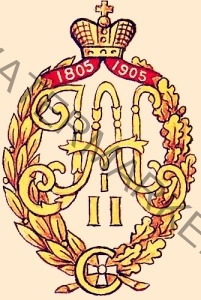
This regiment went through many different names! I wonder if there was a particular reason?
- 1805 – Jun 14 : First created as the «Caspian Marine Battalion» (Каспийский морской батальон).
- From 1830 – Jan 18 – 1842 – Aug 29: Caspian Marine Battalion reformed as variously different «№ Georgian Line Battalions».
- 1858 – Apr 8: The name changed again, this time to «Caucasian №21 Line Battalion».
- 1868 – Mar 23: Another change, this time to … «66th Battalion of Baku Province».
- 1874 – Aug 1: Changed to «Baku Local Battalion». 1889 – Sept 20: Now known as «12th Reserve Infantry Caucasian (HR) Battalion».
- 1891 – Mar 25 : Renamed the «Salyan Reserve Infantry (HR) Battalion».
- 1892 – Dec 26 : Now called the «Salyan Reserve Infantry (HR) Regiment».
- 1899 – May 26 : And now it was called «262nd Infantry Regiment Reserve Salyan». 1907 – Jul 30 : Getting closer … it is now the «262th infantry reserve Salyan His Imperial Highness Tsarevich Regiment».
- 1910 – Feb 20 : And finally … on that day in 1910, it was called the «206th Infantry Salyan His Imperial Highness Tsarevich Regiment».
- 1914 – Jan 1 : The regiment was made part of the 1st Brigade of the 52nd Infantry Division of the 3rd Caucasian Army Corps.
[Source: Our Baku]
NOTE : Now I would stress that I don’t know if the dates mentioned were from the Julian calendar – they probably were so that means they would be 12 days behind our present calendar; therefore June 14, 1805 would read June 26, 1805 in the Gregorian (Western) calendar. The Julian calendar was used in pre-WWI Russia but in 1918 they adopted the Gregorian calendar. I must say I got totally confused when I looked at my parents’ birth certificates as the dates weren’t the days we celebrated their birthdays :/ Thankfully I realised that the dates were from the Julian calendar and everything fell into place 😀
The back (L) and front (R) of the Regimental Banner
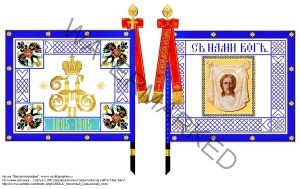
My aunt wrote that Joseph went to Persia as ADC to the 206th Commanding Officer prior to WWI. I found that the 206th was indeed dispatched to Persia with other Cossack regiments in 1911 during the civil war.
The Battle of Ardabil 1912
In the Spring of 1908, the Shahsevan (Šāhsevan) tribes of Azarbayjan-E Gharbi (also spelled Azarbayjan-e-Sharqi) a province in northwest Persia, were involved in a number of border incidents between the tribesmen and Russian frontier guards and this gave the Russians the opportunity for military intervention.

According to Wiki, Azerbaijan or Azarbaijan (Persian: آذربایجان; Āzarbāijān; Azerbaijani: آذربایجان), also Iranian Azerbaijan is a region in northwestern Iran. It is also historically known as Atropatene and Aturpatakan. This map shows you the places we’re talking about … How confusing is this? Coming from Baku, which – of course – in those days was part of Imperial Russia but now called Azerbaijan, into a province called Azarbayjan, which was in northwestern Persia. It’s enough to make anyone’s eyes water when it comes to genealogical research ?♀️
You can see how “easy” it would have been for Joseph’s regiment to go from Baku down to Ardabil as it was almost on the border with Imperial Russia. It was approximately 384kms from town to town down through Salyan, Bilasuver and Germi, both inland from Masalli, before reaching Ardabil … 
Anyway, back to the subject!! In the autumn of 1911, there were attacks on the Russian troops in Tabriz so the Tsar ordered more troops to Tabriz to protect Russian and foreign interests there.
 |
 |
Major General Afoko Patsievich Fidaroff was in charge of the Russians in Persia and by 1912 he had 5000 troops under his command and as the Shahsevan tribesmen started wide-scale looting in the spring of that year and in late April, a Russian convoy was attacked and several Cossacks were killed.
On May 22 of that year, Fidaroff ordered his troops, including the 206th Salyan, to subdue the tribes in order to stop their raids in the area. He sent one battalion of the 206th Salyan, 200 Cossacks from the 1st Labinsky and two 76-mm mountain guns to unseat the Shahsevan, who had fled to their stronghold on the top of Savalan in Meshgin Shahr (Khiav).


Savalan is the 3rd highest peak in Persia and as you can see from the picture, the countryside favoured the defenders. Lt Col Eugene V Maslowski, General Fidaroff’s Chief of Staff, wrote in his memoirs about the fight: «We had to shoot them down (Shahsevan) step by step with each ridge, with each height, and they shot down one, held the following, the team over the previous position.»
It took 9.5 hours of hard fighting, from ridge to ridge, but in the end the Russians were victorious, despite their losses which included 3 killed and 7 wounded from the Salyan Regiment. It must have been a terrible battle – the Russians fighting tooth and nail to get to the top of Savalan and beat the 2000 Shahsevan fighters holding their positions at the top of the volcano
World War I
When WWI started, Joseph would have been transferred with the regiment but where? He sent Balia this photo with the inscription about «Lomzhinski memories». There was a Russian fortress in Łomża, a city in NE Poland so could it be that that he was referring to?!
The Russians were guarding that during 1914-1915 but the Germans pushed them back and took the fortress in the early days of August 1915. Was this photo taken when the Russians had the fortress, I wonder?

and there was this inscription on the back, like it was a postcard …

Translation of the back …
It was addressed to:
Baku, Bayilov(*)
Private house E.V.B.
To: A.V.Borodinov
For AnyaAnd on the right hand side it said:
My darling
Lomzhinski(**) memories. Do you remember the photography place (near the post office) that we passed by? I kiss you and wait for your photo, which I have been waiting for without success. I got a group (photo) from Mom and Dad and Lida(***), (but still waiting) from you. Hedgehog.
[Kindly translated by Inna Donaldson](*)Bayilov was/is a residential area on the coast in Baku, which today is the capital of Azerbaijan.
(**)Łomża Governorate (Russian: Ломжская губерния; Polish: Gubernia łomżyńska) was an administrative unit (guberniya) of Congress Poland with seat in Łomża. Some divisions of the Russian Imperial Army were stationed there during WWI so I assume the photo was taken there.
(***)Joseph was referring to Balia’s parents and Lida (Lydia), her half sister, so they must have been married when he wrote it in 1915.
Stefan Hubitski (Stefan Hubicki) was a military doctor with the 208th Salyan, which was part of the 1st Brigade of the 52nd Infantry Division of the 3rd Caucasian Army Corps. Regimental commander at the time was Colonel I P Romanovsky.
In August 1915 the Salyan regiment retreated to Pribuzhie and the doctor took a lot of photos of movements on the frontline roads: Wlodawa, Volchin Lake Selyahi, Terespol, Brest-Litovsk, Andronovo near Kobrin, Lyahovichi, Bobruisk.
The III Caucasian Army Corps was mentioned a few times in a book by Bernard Pares, who was appointed official observer to the Russian Army and later seconded to the staff of the British Embassy in St Petersburg / Petrograd during WWI.

Bernard Pares (Click to enlarge)

He wrote a book called «The Fall of the Russian Monarchy: A Study of the Evidence» which was published in 1939. In it, he mentions the III Caucasian Army Corps several times. One example …
«Here he (Grand Duke Nicholas) visited Lemberg and some sections of his army, being particularly delighted with the spirit of the splendid 3rd Caucasians of Irmanov, who had just been brought up to strength and were quartered at the foot of the Carpathians.» [page 226]
Another example of Bernard’s admiration for the III Caucasians was this quote …
“Allah Verdi” The name, which means «God Has Given Us The Victory», came from the battle cry of the 3rd Caucasus Army Corp, of which his regiment was a part of during WWI. [page 207]
The Brusiloff (Brusilov) Offensive

Click to enlarge
The Brusiloff Offensive (also known as the Brusiloff Breakthrough – «Брусиловского прорыва») was a large tactical assault carried out by Russian forces against Austro-Hungarian forces in Galicia between June-August 1916 under the leadership of General Alexei Brusiloff. He replaced General Ivanoff as commanding officer of the Southwestern Front on March 17, 1916.
To help the Allies in the Battle of the Somme, the Russians planned a major attack in the east so that the Germans would have to split their forces between both fronts.
It was decided that Brusiloff would launch at attack by the Southwestern Front that would be followed by attacks by the other two fronts with General Kuropatkin leading an attack from the Northern Front and General Evert from the Western Front.
Grand Duke Mikhail was also involved in this Offensive as commander of the Caucasian Native Mounted Division.
The Division (Russian: Кавказская туземная конная дивизия), or «Savage Division» (Russian: Дикая дивизия) was a cavalry division of the Imperial Russian Army, formed in 1914. It was made up of six regiments of volunteers from the various mountain peoples of the region: the Circassian, Kabardin, Ingush, Chechen, Daghestanis and the Tartar Regiment from Azerbaidjan. The Division was to achieve fame with its early victories over the Austrians on the Galician Front.

Count Vorontzoff-Dashkoff, the Viceroy of the Caucasus, was the one who came up with the idea of this division and, knowing the Grand Duke so well, as he was considered a very good friend of the Count’s son, he recommended that he be made commander.
In 1907 Grand Duke Mikhail was «persona non grata» with his family as he fell in love with Natalia Sergeyevna Wulfert who was, at the time, a married woman and, worse still, she wasn’t an aristocrat! 😮
His brother, Nicholas II, more or less banished him to Orel, to avoid any scandal, but Mikhail kept on popping back into Russia to see his love and, in 1910, Natalia produced a son which they called George. Then, in 1912, Misha married his Nata and his mother and brother were totally stunned, as he’d apparently promised that would be something he wouldn’t do! 🙁
It’s hard in these days to know about what duty meant to families but certainly at the beginning of the 20th Century, especially for Royalty, it meant a lot! A morganic marriage was just the pits for the Imperial Family 🙁 Mikhail spent those years with his wife and son away from Russia but, when WWI started, Mikhail sent a telegram to his brother asking if he could return to Russia and so was given the command of the “Savage Division”!
Mikhail had a wonderful personality – he was kind, generous and very warmhearted, and he became much loved and respected by his men.

Grand Duke Michael with his officers during the Brusiloff Offensive (Click to enlarge)

The forces of the Southwestern Front took Lutsk on June 8 and the Austrian commander, Archduke Josef Ferdinand, barely managed to escape the city before the Russians entered, a testament to the speed of the Russian advance. By now the Russians had taken over 200,000 prisoners and the Austrians were in full retreat. Unfortunately Brusiloff’s forces were becoming overextended and despite making it clear that it was necessary for Evert to send his men to ensure further success.
He was a very capable and popular commander and it wouldn’t surprise me if he and Joseph knew each other, even if only casually 😉

Joseph is in the row behind and to the right of the officer with the white Cossack hat (Click to enlarge)
For some reason General Evert continued to delay, and it gave the Germans time to send reinforcements 🙁 The III Caucasian Army Corps saw heavy action against the Austro-Hungarian Army in southern Poland during this offensive, losing over half of its men but despite the casualties, the men stood their ground and kept their positions.

Playing games at the Front. Joseph is to the right of the blindfolded man
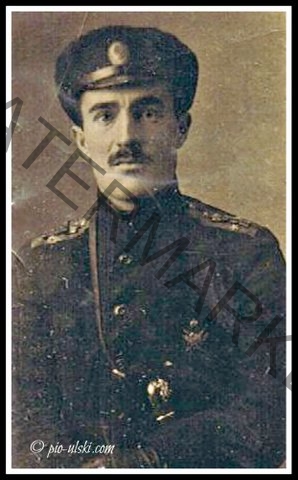
Click to enlarge
I knew from my mother that Joseph had been wounded during the war but then I found a site where I found more information about Joseph and found out that he was wounded twice during WWI — in 1914 and again in 1916 😮
The First World War, 1914–1918 – The project of Union of Revival of Pedigree Traditions
Нозадзе Иосиф Давидович (не указано) {Nozadze Joseph Davidovich (not specified)}
| Military rank: | Подпоручик {Second Lieutenant} |
|---|---|
| Religion: | (не указано) {(not specified)} |
| Marital status: | (не указано) {(not specified)} |
| Event: | Ранен {Wounded} |
| Event date: | 07 окт.1914 {07 Oct 1914} |
| Source: | “Журнал военный и литературный “Разведчик” №1249”, pg.692 |
You can download the pdf of the magazine HERE.
Below is a screenshot from «Журнал военный и литературный “Разведчик” №1249», pg.692 (“Military and literary magazine “Scout “) which had Joseph’s name in it. There was nothing else written – just his name!

I found a reference to Joseph’s 1914 wounds on this site
Нозадзе Иосиф Давидович (не указано) {Nozadze Joseph Davidovich (not specified)}
Military rank: Подпоручик {Second Lieutenant}
Religion: (не указано) {not specified}
Marital status: (не указано) {not specified}
Event: Ранен {Wounded}
Event date: 07 окт.1914 {07 October 1914}
Source: “Журнал военный и литературный “Разведчик” №1249”, pg.692 {“Military and literary magazine” Scout”}
It really is terrific how more and more Russian sites are opening up and so my research is actually getting results, slowly but surely 😀
I found another site which is called «Памяти героев Великой Войны 1914-1918» (In memory of the heroes of the Great War of 1914-1918) and found information about my grandfather being wounded during WWI. I was aware of that as my mother told me he’d been invalided out because of his injuries and it was great to have that confirmed!
****
He couldn’t have been badly hurt as he was back in the fray of things the following year. Then he was wounded again in 1916 …
| Должность/звание: подпоручик; поручик; капитан Воинская часть 206-й пехотный Сальянский полк Дата события: 17.09.1916 Тип карточки: Карточка офицерской картотеки Место сражения: Обренчовск. лес Судьба: Ранен(а)/Контужен(а) |
Position / Title: Second Lieutenant; Lieutenant; captain Military unit of the 206th Infantry Regiment Salyan Date of event: 09/17/1916 Card type: Officer card index card Place of battle: Obrenchovsk. forest Fate: Wounded / Concussion (s) |
Нозадзе Иосиф Давидович (Nozadze Joseph Davidovich)
Должность/звание: поручик (Position / Title: Lieutenant)
Воинская часть 206-й пехотный Сальянский полк (Military unit of the 206th Infantry Regiment Salyan)
Дата поступления: 04.10.1916 (Date of receipt: 04/10/1916)
Тип карточки: Карточка на прибывших (Card Type: Card on Arrivals)
Место лечения: Киевская губ., г.Черкассы (Place of treatment: Kyiv Gubernia, Cherkasy)
Судьба: Ранен(а)/Контужен(а) (Fate: Wounded / Concussion (s))The stamp at the bottom of the card says “134th Reserve Field Hospital” and it was dated 4/X/1916.
Нозадзе Иосиф Давидович (Nozadze Joseph Davidovich)
Должность/звание: подпоручик; поручик; капитан (Position / Title: Second Lieutenant; Lieutenant; captain)
Воинская часть 206-й пехотный Сальянский полк (Military unit of the 206th Infantry Regiment Salyan)
Тип карточки: Карточка офицерской картотеки (Card type: Officer card index card)
Судьба: Ранен(а)/Контужен(а) (Fate: Wounded / Concussion (s))and another entry for Joseph, with the same cards …
Должность/звание: подпоручик; поручик; капитан (Position / Title: Second Lieutenant; Lieutenant; captain)
Воинская часть 206-й пехотный Сальянский полк (Military unit of the 206th Infantry Regiment Salyan)
Дата события: 17.09.1916 (Date of event: 09/17/1916)
Тип карточки: Карточка офицерской картотеки (Card type: Officer card index card)
Место сражения: Обренчовск. лес (Place of battle: Obrenchovsk. forest)
Судьба: Ранен(а)/Контужен(а) (Fate: Wounded / Concussion (s))

|
|


The translation of the right-hand card :
1) A telegram from Commander of the Third Caucasian Army Corps, General L. Irman 15 Sept (?) 1914. No 1140 (Corps Commander (1912-1917) was Irmanov Vladimir Aleksandrovich-from the Russian Wikipedia)
2) Telegram of the Chief of Staff of the 3 Caucasian Army Corps, G. M. Rozanov, dated September 25, 1916. No 10680/168784
In the winter of 1916-1917, on the eastern front of the First World War, in the area of Lithuania and Belarus, starving wolves greatly increased in size around cities and army camps and began to attack small groups of soldiers. Seeing this, the command of the Russian and German armies agreed on a temporary truce and sent forces to destroy the wolves. After several hundred animals were killed, and the threat from them was over, hostilities resumed.
[Source: Российская империя : все факты и история, VK.com]
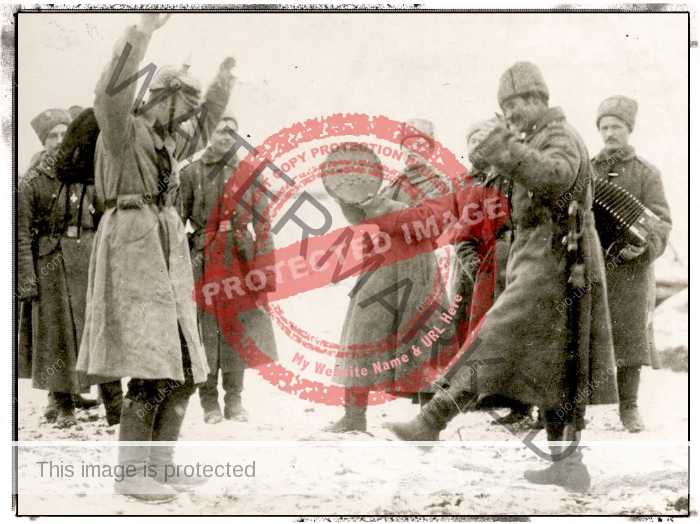
Click to enlarge
As I posted on the page about Joseph, these are the awards my nephew found that he won after his time fighting during World War I. These are his words, not mine …
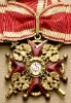
Joseph won a total of 6 battlefield medals for bravery. He was awarded the following orders …
St Stanislaus 3rd Class with swords and bow
(on February 27, 1915)St Anna 3rd Class with swords
(July 3, 1915)St Anna 4th Class with the legend “For Gallantry”
(on April 1, 1915)St Anna 3rd Class with swords and bow
(August 19, 1915)St Stanislaus 2nd Class with swords
(on June 3, 1915)St Anna 2nd Class with swords
(May 1, 1917)As my Russian researcher wrote to me, «according to this, he would have been considered a heroic military officer».
The Order of St. Anna, which ranked just below the order of St. Vladimir in the Imperial Russian hierarchy, was originally an award from Schleswig-Holstien, named by the Duke of Holstein after his wife, Anna Petrovna (Peter the Great’s daughter). It became a Russian award in 1742, when the prince of Schleswig-Holstein ascended the Russian throne as Czar Peter III. It came in four classes. The top three classes could be awarded with swords for gallantry in action or military merit in times of war. The lowest (4th) class of the order was marked by “St. Anna’s Weapon.” A small badge of the order was attached to a steel edged weapon (appropriate to the branch of service of the recipient) inscribed “For Gallantry.” The gold edged red ribbon of the order made up the sword knot.The Order of St. Stanislaus. First instituted in 1765 by Stanislas Augustus Poniatowski, last king of Poland prior to the partition. The order ranked second only to the White Eagle. As a Russian Order, double-headed imperial eagles replaced the Polish eagles between the cross arms. The Order came in three classes:
- Knight’s Grand Cross, worn on sash. Star.
- Commander, worn at the neck.
- Companion, worn on the breast.
Swords were added for a military award in war.
*NB – when you click on the album, the screen will show the top of this page. Please just scroll down to see the pictures.206th Salyan and other photos taken during WWI
Various photos of Joseph's regiment and his time in it, as well as other photos


 The Russian Way in Warfare – The Brusilov Offensive
“Savage Division” of Russian Imperial Army – site has a number of very interesting photos of the «Savage Division» or perhaps the «Wild Division», as it was also known as 🙂
A video showing WWI – Russian Military Preparation & Fighting
A video of the Imperial Russian Anthem, which was discontinued in 1917
“Farewell of Slavianka” (Russian: Прощание славянки, romanized: Proshchaniye slavyanki) is a Russian patriotic march, written by the composer Vasily Agapkin in honour of Slavic women accompanying their husbands in the First Balkan War. The march was written and premiered in Tambov in the end of 1912. In the summer of 1915, it was released as a gramophone single in Kiev. Slavianka means “Slavic woman”.
The melody gained popularity in Russia and adjoining countries during the First World War, when the Russian soldiers left their homes and were accompanied by the music of the march. It was performed also during parade of 7 November 1941 on the Red Square after which soldiers went straight to fight in the Battle of Moscow. This march was also used as an unofficial anthem of Admiral Kolchak’s White Army.
“Farewell of Slavianka”
https://www.youtube.com/watch?v=5tPSyXe5rd4
Pio-Ulski.com claims no credit for any images posted on the site, unless explicitly stated.
All copyright goes to their respective owners.