
— Mogilev (Могилев), Belarus ~ pre-1917
Mogilev/Mahilyow
|
|
|
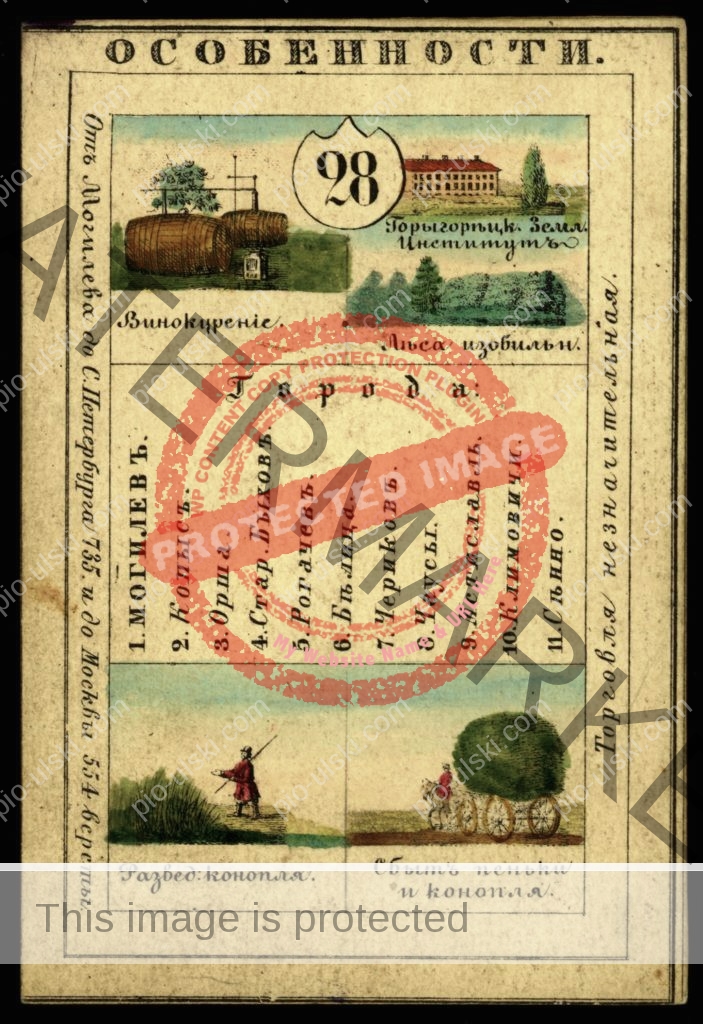
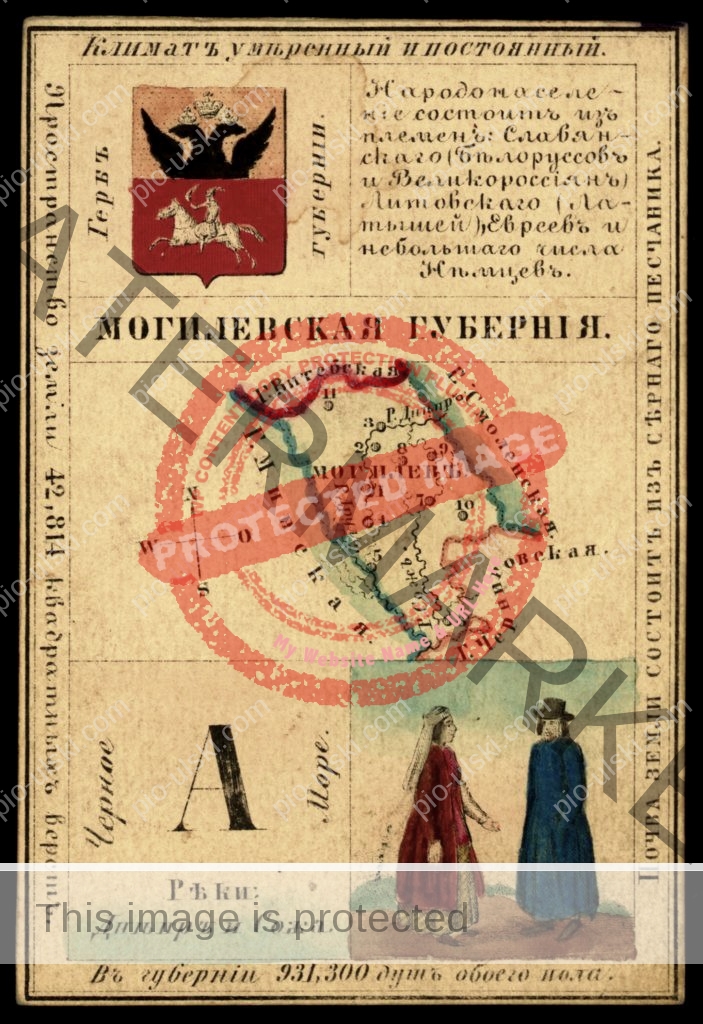
Mogilev Province, Russian empire, 1856 – Российская национальная библиотека
Mogilev Province
This card is one of a souvenir set of 82 illustrated cards–one for each province of the Russian Empire as it existed in 1856. Each card presents an overview of a particular province’s culture, history, economy, and geography. The front of the card depicts such distinguishing features as rivers, mountains, major cities, and chief industries. The back of each card contains a map of the province, the provincial seal, information about the population, and a picture of the local costume of the inhabitants.
Могилевская губерния Это открытка из сувенирного набора, состоящего из 82 иллюстрированных открыток, по одной на каждую провинцию Российской Империи в том виде, как она существовала в 1856 году. На каждой открытке представлен обзор культуры, истории, экономики и географии провинции. На лицевой стороне открытки описаны главные отличительные особенности провинции: реки, горы, крупные города и ключевые отрасли промышленности. На оборотной стороне каждой открытки изображены карта и печать провинции, приводится информация о населении, а также изображена традиционная одежда местных жителей. 1856
Mogilev / Mahilyow, also spelled Mahilyoŭ, is a town in east-central Belarus which is situated on the upper Dnieper River, between Vitebsk and Smolensk on the north and east, and Chernigov and Minsk on the south and west. 
Belarus, translated, is «White Rus» (pronounced «Byela Rus» or «Biala Rus»), and was part of the Russian Empire pre-World War I. The country got that name because of the many white hares that roamed the countryside. It was inhabited by the Dregoviches, an early tribe of East Slavs, back in the 9th and 10th centuries.
Mogilev was originally established as a fortress back in 1267 and only became a town in 1526, when it was under Lithuanian rule. After the first partition of the Polish-Lithuanian Commonwealth of Belarusian territories were ceded to Russia in 1772, it became Russian and the northern part became part of the province of Pskov.
Thirty years later, in 1812, a major engagement with Napoleon’s troops took place outside the town.
Mogilev had for long been a significant trading centre whose importance was much enhanced by the coming of the railway in 1904.
Back in the days of the tsars, the Empire was divided up into provinces which were called «gubernias» (Губернии) and Mogilev was the administrative-territorial area to the west of the Russian Empire.

Coat of arms of Mogilev Governorate during the Russian Empire
In 1777 Mogilev province was divided into 12 counties . In 1778 the province was renamed as the Mogilev governorship , but that was abolished in 1796 and the counties were included in the Belarusian province.
In 1802 Mogilev province was restored as part of the previous 12 counties. Mogilev was the «capital» of Mogilev district, which was in Mogilev province.
In a Russification drive in the 1840s, Nicholas I forbade the use of the term Belarusia and renamed the region the «North-Western Territory». He also prohibited the use of Belarusian language in public schools, campaigned against Belarusian publications and tried to pressure those who had converted to Catholicism under the Poles to reconvert to the Orthodox faith.
Economic and cultural pressure exploded into a revolt in 1863 but it failed. A year later, in 1864, the Russian government reintroduced the use of Cyrillic and banned the use of the Latin alphabet in Belarus.

During WWI, the Russian Army had to find another city for their Supreme Military Headquarters (Stavka) after they had to evacuate the headquarters from Baranovichi, a town situated in the Brest region of western Belarus. The name “Stavka” came from an old Russian word which meant “camp of a military chief“.
The Joint Staff decided that Mogilev would fit the bill due to its situation and also its size, plus the fact that it had a railway line which had been put in just 11 years earlier.
Tsar Nicholas and his family used to travel to Mogilev by train and there are several photos of him reviewing the troops there, with his young son by his side.

The Tsar would give the authorities and soldiers there a headache as he didn’t want to move into the Governor’s Residence but decided to live on the train when he was there.
Nicholas wrote about the first occasion he stayed in Mogilev in his diary :
«August 23, Sunday. I slept well. The morning was rainy: in the afternoon the weather changed to better and it became very warm. At 3.30 arrived to my headquarters, which is one milestone away from Mogilev. Nicholasha was waiting for me. Having spoken to him, I went to look around. The train stays in a small dense forest. I had lunch at 1 o’clock, than walked around a little bit more. The evening was splendid.»
The Tsar’s train line was located at a private pine forest, not far from the goods station. The forest, with its dead-end track, was a perfect location for the Imperial train, as it was in a very picturesque place and well hidden from any German planes.
The next day, August 24, there was a lot of excitement in Mogilev as everyone got ready to welcome the Imperial Family. Although previous tsars had visited Mogilev, it was the first time that Nicholas II visited the town.
The following account was written by Boris Sidorenko, Mogilev’s regional ethnographer (with some grammatical corrections on my part) …
«On August, 24, there was an unusual excitement in the streets of Mogilev, the city inhabitants were getting ready to welcome the Russian Emperor. Mogilev had been previously visited by the representatives of Romanov Family, such as Alexei Mikhailovich, Peter I, Catherine II (though she was not from Romanov family, yet an Empress), Paul I, Alexander I. However this was the first visit of Nicholas II to Mogilev.
Everybody was getting ready for the Tsar red-carpet welcome. The governor, Pilts, drove to the Tsar’s railroad branch line in the early morning, so that, as per tradition, having been guberniya head, to enter the city prior to the Tsar, as if showing him the way. Nicholas II wanted to receive a welcome as per peace-time traditions and ceremony; all the troop units of the city were lined up along the route of march, anthem was being played and all the city was decorated with three-color flags.
With joy bells the Emperor, following the governor, together with his uncle Nicholas Nicholaevich arrived to Iosifskiy Cathedral. The vice-governor and eminents Constantine and Varlaam welcomed Nicholas II at the Cathedral porch. After solemn moleben*the Tsar was greeted with bread and salt at the stairs by Mayor S. I. Kazanovich, then he visited the Headquarters and had breakfast on the Imperial train to which the top officials of Mogilev’s guberniya, chief officers of the HQ and members of imperial court were invited.»
Nicholas II was dressed in a common officer’s blouse with shoulder straps of colonel of the 1st squadron of the Preobrazenskiy regiment, high boots and without weapon. Having greeted everybody and shaken hands, the Emperor poured himself a small silver glass of vodka, took some food and stepped aside, giving place to the others. After breakfast, consisting of three courses and fruits, coffee was served. Having drunk it, the Tsar lighted up a cigarette. Everybody followed his example.
Gradually life at Headquarters got into a groove and the city life became more active and lively. An officer with a lady became the major figures on the Dneprovsky Avenue and Bolshaya Sadovaya. A wonderful theatre troop was established in Mogilev, two cinemas were working. On the archway at the city garden entrance it was written «Welcome!», and at the reverse side – «Please, take a walk some more!»
The Tsaritsa, Grand Duke Tsarevich Alexei Nikolaevich, Dukes Dmitri Pavlovich, Boris Vladimirovich and other members of Tsar’s house and escort were often seen in the streets of the city.
Mogilev, as a place of the headquarters location, became a real residence of the Tsar’s family, the war didn’t seem to be so acute. Life in the city was too exiting, so people were not thinking about horrors of the war. It’s clear that it was neither Nicholas II, nor his family’s fault. At that time it would not occur to anyone that in future there would be terrible changes.»
*(A «Moleben» is a liturgical service of supplication or thanksgiving. Unlike the Divine Liturgy and the offices of the daily cycle, it can be celebrated at any time and in a variety of locations.)

My father’s grandfather was a Nadvórnyy sovétnik (Надво́рный сове́тник) which in English means “court counselor“. It was an important position and I’m sorry that he wasn’t around when the Tsar visited Mogilev during the war!
My father said his family had a house on Dneprovsky Prospect, so I wonder if they lived in the house described here…
The nobility assembly was never located in this house. The Noble Assembly had its own house at the corner of Dneprovsky Prospect and Dvoryanskaya Street, next to the theater.
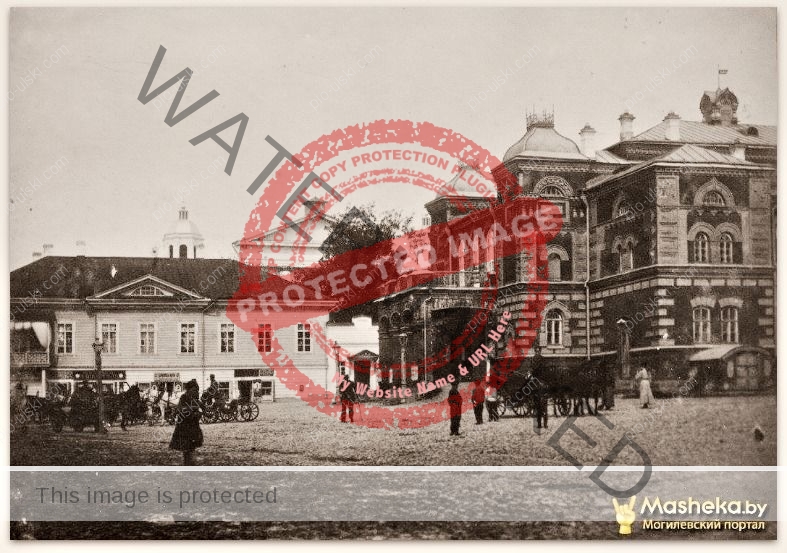
Actually for this reason, the street got its name, becoming today Komsomolskaya. The nobility building was a two-story building. The first floor was leased to various shops, and the second was used by the nobility assembly itself. There were meetings of deputies of the provincial nobility, was the office. In the same house he lived the leader of the provincial nobility.


Articles (in Russian) about the Imperial Family in Mogilev
 Могилев. Память о Ставке и царской семье (Mogilev. The memory of the Stavka and the royal family)
Царская семья в Могилеве (Tsar’s family in Mogilev)
История Могилева / Могилев в жизни Николая II (The history of Mogilev / Mogilev in the life of Nicholas II)
ЦАРСКАЯ СЕМЬЯ В МОГИЛЕВЕ. ИЗ СОБРАНИЯ ГАРФ (TSAR’S FAMILY IN MOGILEV. FROM THE GARF COLLECTION)
Stavka: Mogilev Headquarters WW1 | Romanov Family Photo Albums
The Romanov Family visit Mogilev, October 4th 1916
Pre-Revolutionary Mogilev …
Pio-Ulski.com claims no credit for any images posted on the site, unless explicitly stated.
All copyright goes to their respective owners.
Leave a Reply